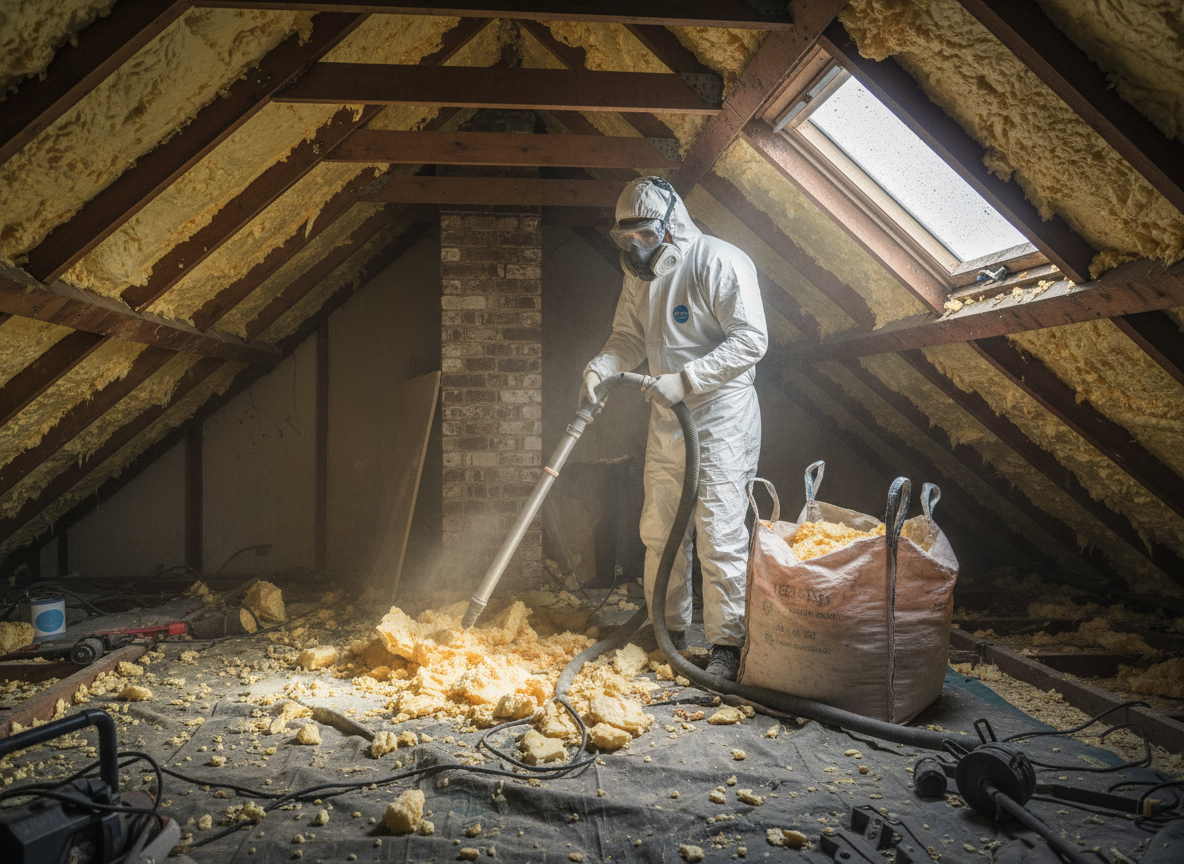
Cheltenham's housing stock includes many Victorian and Edwardian terraces and semis where closed-cell spray foam was applied directly to rafters and ceilings in the 2000s. Over time the foam traps moisture against timber that already faces high rainfall and poor loft ventilation typical of the Cotswold fringe. Removal requires careful cutting and peeling to avoid pulling lath and plaster or disturbing original roof felt, especially on properties near the town centre or in Pittville where ceilings are often fragile.
Edge cases arise when foam has expanded into eaves and behind chimney stacks, common in Gloucestershire stone and brick homes. Technicians must work around electrical cabling and pipework that runs through lofts, using negative air machines to control dust during mechanical removal. Post-removal inspection often reveals timber decay or blocked soffit vents that need addressing before any new insulation is considered, preventing repeat issues in the wet winters the area experiences.
Homeowners sometimes attempt DIY scraping, which leaves residue that prevents proper adhesion of replacement insulation and can void any future roof warranty. Professional teams use solvent gels and hand tools suited to the foam type found locally, followed by thorough vacuuming and disposal compliant with waste regulations. The base on Runnings Rd allows quick response across Cheltenham and nearby areas like Charlton Kings and Prestbury where access is often via narrow rear lanes.
Technician insight
In Cheltenham, the thing that catches most people out with loft spray foam removal is how the foam bonds to the thin lath and plaster ceilings in Victorian terraces around the town centre and near Montpellier. After years of damp winters the plaster is already weak, so any aggressive pulling brings chunks down and turns a straightforward job into ceiling repairs.
Foam Removal in a Charlton Kings Semi
Homeowner noticed musty smell and stained ceiling plaster after heavy autumn rain. Inspection found closed-cell foam trapping moisture against rafters in the 1930s loft. We cut and peeled the foam in sections, cleared residue from eaves and restored airflow through existing vents. Ceiling remained intact and the loft dried out over the following weeks.
How it works
- 1
Initial Loft Assessment
Inspect foam type, depth, attachment to rafters and any signs of trapped moisture or timber damage in Cheltenham properties.
- 2
Containment and Dust Control
Set up sheeting, negative air filtration and access routes to protect living spaces below during removal.
- 3
Mechanical and Chemical Removal
Cut, peel and apply targeted solvents to lift foam without harming original roof structures or ceilings.
- 4
Clearance and Site Clean
Vacuum all residue, remove debris and check ventilation paths before leaving the loft ready for further work.
Pricing
Cost depends on loft size, foam thickness and access difficulty; upfront quotes provided after inspection.