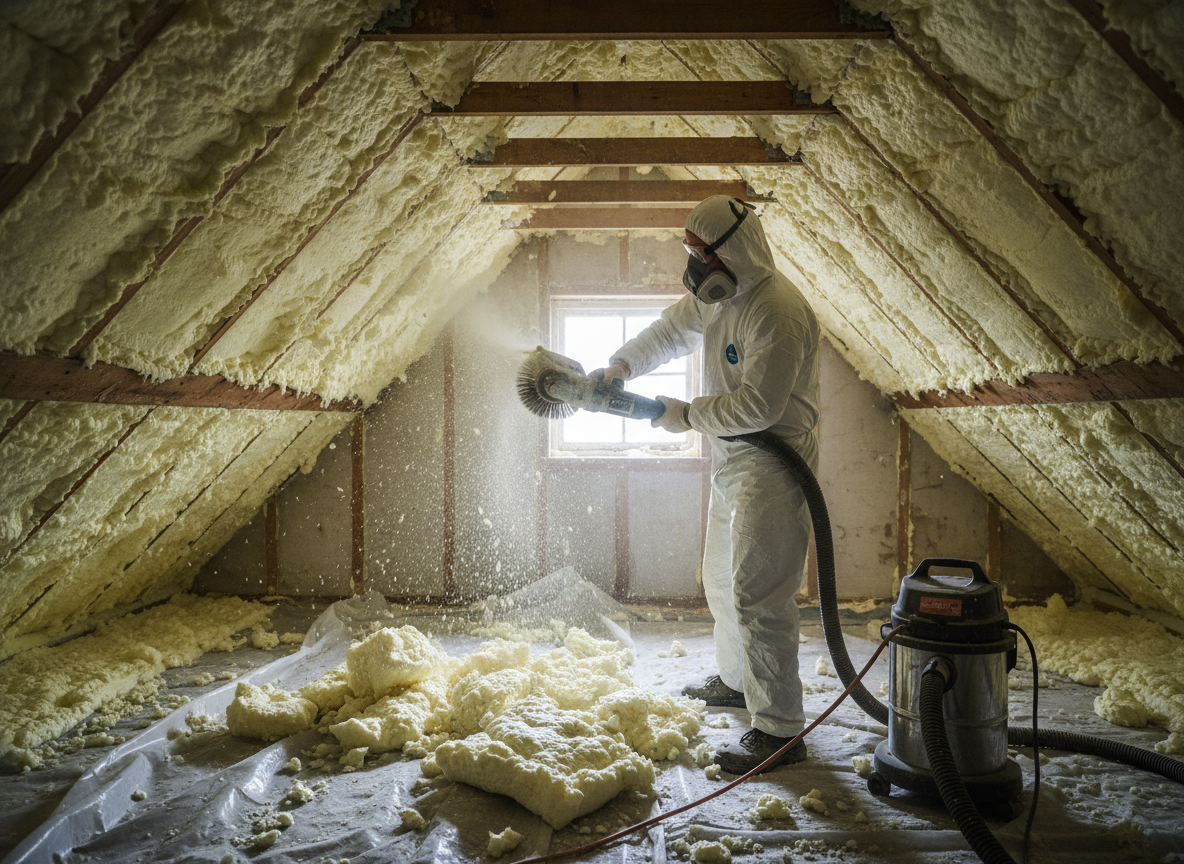
Open cell spray foam bonds tightly to rafters and roof decks in Cheltenham terraces and semi-detached homes built before the 1950s. Removal requires cutting the foam into sections without damaging underlying timbers that have already absorbed years of Gloucestershire rainfall. Crews working from Runnings Rd often find the foam has wicked moisture into lath and plaster ceilings below, especially after repeated winter storms that leave attics with poor airflow.
Edge cases appear in properties around Cheltenham Racecourse where foam was sprayed over electrical cables or into eaves that connect to neighbouring roofs. These jobs demand careful isolation of services before any mechanical removal begins. Homeowners frequently underestimate how the foam's open structure traps dust and insulation fibres, requiring full containment and HEPA filtration to prevent contamination of living spaces below during extraction.
Local building practices in the Cheltenham area mean many roofs have minimal ventilation gaps once foam fills the rafter voids. Removing the material often reveals original felt underlay that has degraded, allowing water ingress that must be addressed before any new insulation is considered. Work at height on steep pitches common to Victorian stock adds time and requires extra fall protection that flat-roof jobs elsewhere do not need.
Technician insight
In Cheltenham, the thing that catches most people out with open cell spray foam removal is how the foam was often sprayed straight onto the underside of slate roofs in pre-war terraces without any vapour barrier, so once winter rain soaks through the tiles the foam holds that moisture against the rafters for years.
Hidden Moisture in Montpellier Terrace Attic
Homeowner noticed ceiling stains after heavy autumn rain. Inspection found open cell foam trapping water against rafters in a 1930s semi near Montpellier. We removed the saturated foam in sections, dried the timber, and cleared debris without disturbing the original lath ceiling below.
How it works
- 1
Site Assessment
Inspect attic access, foam depth, and any signs of moisture staining on timbers or ceilings in the Cheltenham property.
- 2
Containment Setup
Seal off the work area with plastic sheeting and negative air machines to protect living spaces from dust and fibres.
- 3
Foam Extraction
Cut and remove open cell foam in manageable sections, checking for hidden wiring or pipework as work progresses.
- 4
Cleanup and Disposal
Vacuum residues with HEPA equipment and remove all waste from site, leaving the roof void clear for inspection.
Pricing
Cost depends on attic size, foam thickness, and access difficulty in Cheltenham homes; quotes provided after inspection.